
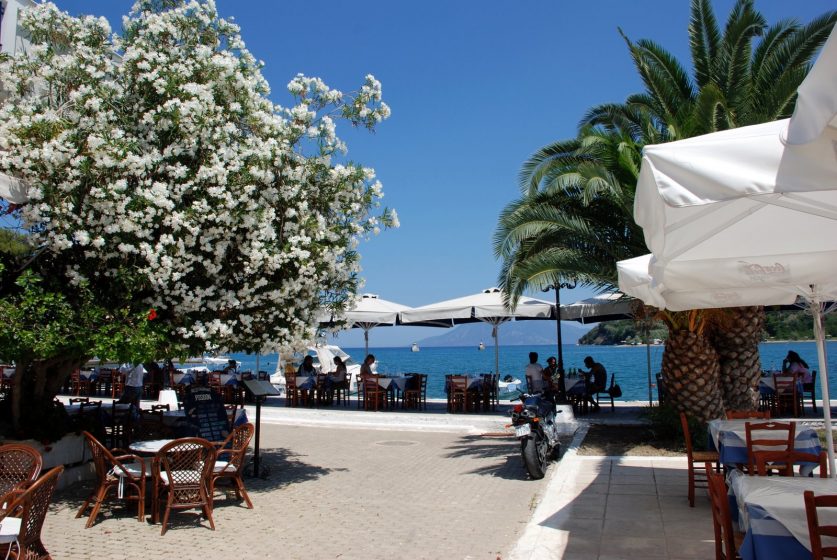
Archaia Epidavros the village
In Mycenaean times, Archaia Epidaurus was a large town with 80,000 inhabitants. Today, it is a small fishing village on the Saronic Gulf and the eastern coast of the Peloponnese with approximately 2,000 inhabitants, who primarily make their living from agriculture and fishing, and from tourism in the summer.
There are several small beaches, tavernas, restaurants, bars, a post office, ATMs, shops, campsites, and many hotels and apartments. There’s a friendly atmosphere here, making you feel welcome.
As you approach Epidaurus by car from Corinth, you’ll see the village surrounded by orange and olive trees. In spring, the entire area is filled with the scent of orange blossoms. The village has a charming fishing harbor where you can buy fish directly from the fisherman in the morning. Around the harbor are many restaurants and tavernas where you can enjoy a wide variety of Greek dishes. The diving school “Scuba Blue” is located at the harbor. This professional diving school caters to both beginners and advanced divers. In the summer, in July, there’s a market every Friday and Saturday evening where you can sample and buy local agricultural products.
The Nisi Peninsula
To the right of the harbor, you’ll see a peninsula. This peninsula once housed the “acropolis,” or “upper city.” A small church stands on the hill, and you can still find remains of walls. Also located here is the small theater, nestled like a shell against the hill below. The theater was built in the 4th century BC and has 18 rows of seats. Excavations began in 1972, but new remains are still being unearthed. In September 2011, a statue of the god Hermes was unearthed here. The theater has been in use again since 1995. Every Friday and Saturday evening in July, a music or theater performance is held there.
On the other side of the peninsula, beneath the water’s surface, lies the “sunken city,” the remains of Epidaurus that disappeared underwater after a volcanic eruption of the volcano on Methana. These remains are still clearly visible.
The Beaches of Epidaurus
Epidaurus has five different beaches, all worth a visit.
The first beach is located to the left of the church of Epidaurus and is called Vagonia Beach. There is very little shade on this beach. There is a changing room, however.
If you climb over the rocks to the left of the beach, you will reach Kalamaki Beach. The beach is very quiet, and the water is also beautiful. However, there are no facilities.
The third beach is the beach on Nisi. This is a peninsula located at the transition between the two bays. It is very suitable for swimming with children, as the beach slopes gently into the sea.
Then there is the beach where you can snorkel to see the remains of the sunken city. You can walk along the walls and see the remains of the jars used to store oil and wine. There are free sunbeds. You can also eat delicious fish here for a reasonable price.
The fifth beach is the beach at Galasi. This beach is located near the campsites and is very busy in summer. Here too, there are free sunbeds and you can get refreshments.
The Theater of Epidaurus
From the present-day village of Archaia Epidaurus, it is only a 10-minute drive to the famous theater of Epidaurus. It is the best-preserved theater in Greece, and the acoustics are so good that performances given in the summer are performed without amplification. If you whisper softly from the ‘orchestra’, the circular stage where the performance took place, every word can be heard in the upper rows. There are always people trying this out, and sometimes you can hear a real talent show.
The theater seats 14,000 spectators and was built in the 4th century BC, with the upper rows added in the 2nd century BC. In the center of the orchestra, a marble slab still stands where the altar to Dionysus once stood. The ancient theater developed around the cult of Dionysus, in which song, dance, and drama played a major role.
The Sanctuary of Asclepius
While most visitors today primarily come to see the theater, people used to come to visit the sanctuary of Asclepius, the god of medicine. The practical medicine practiced there was a blend of traditional knowledge, magic, and psychological therapy, but using methods that could be passed down. Snakes played a significant role in this. The Aesculapius, the serpent coiled around a staff, remains the symbol of modern medicine.
The sanctuary consisted of a temple with the so-called “abaton” behind it, where patients spent the night seeking healing. Next to the temple is a “tholos,” or “thymele,” a circular structure with several columned circles. However, archaeologists still disagree about the building’s function. The architect was Polykleitos the Younger, who also designed the theater.
The archaeological site also includes several other buildings, including the propylon, a gymnasium, a stadium, and the two-story hotel with 160 rooms for pilgrims.